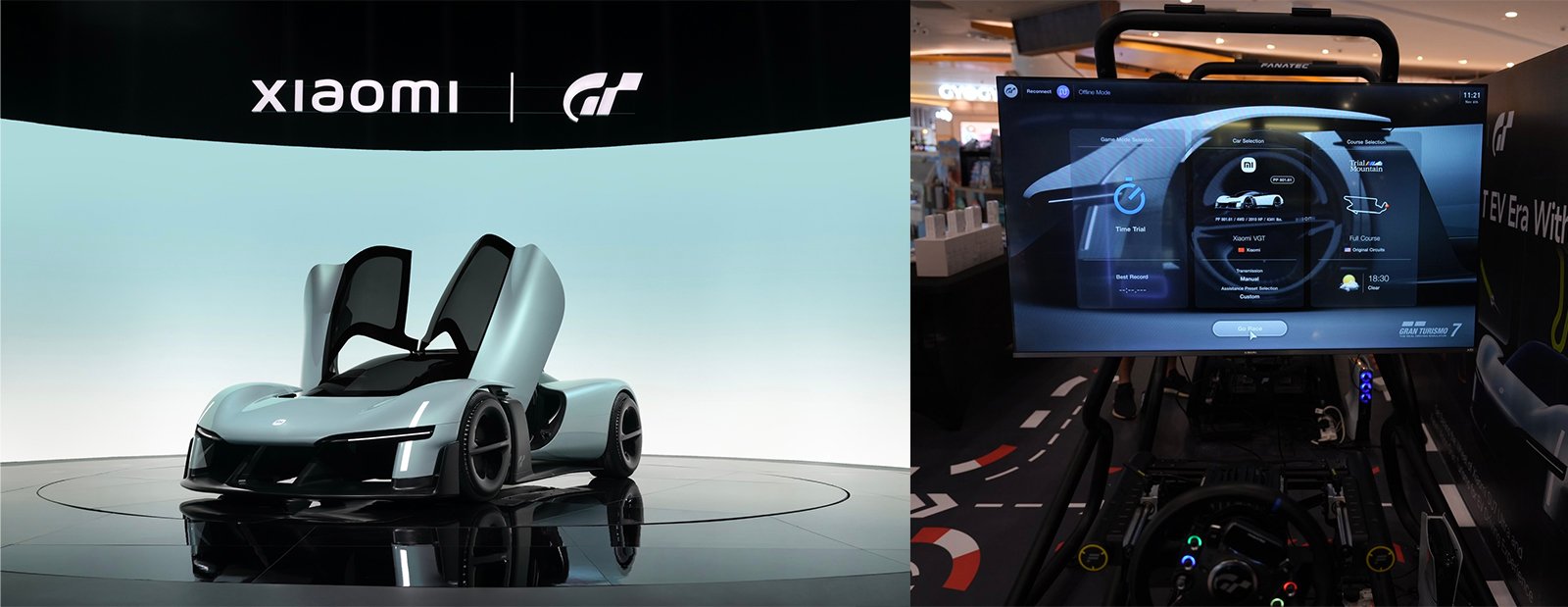
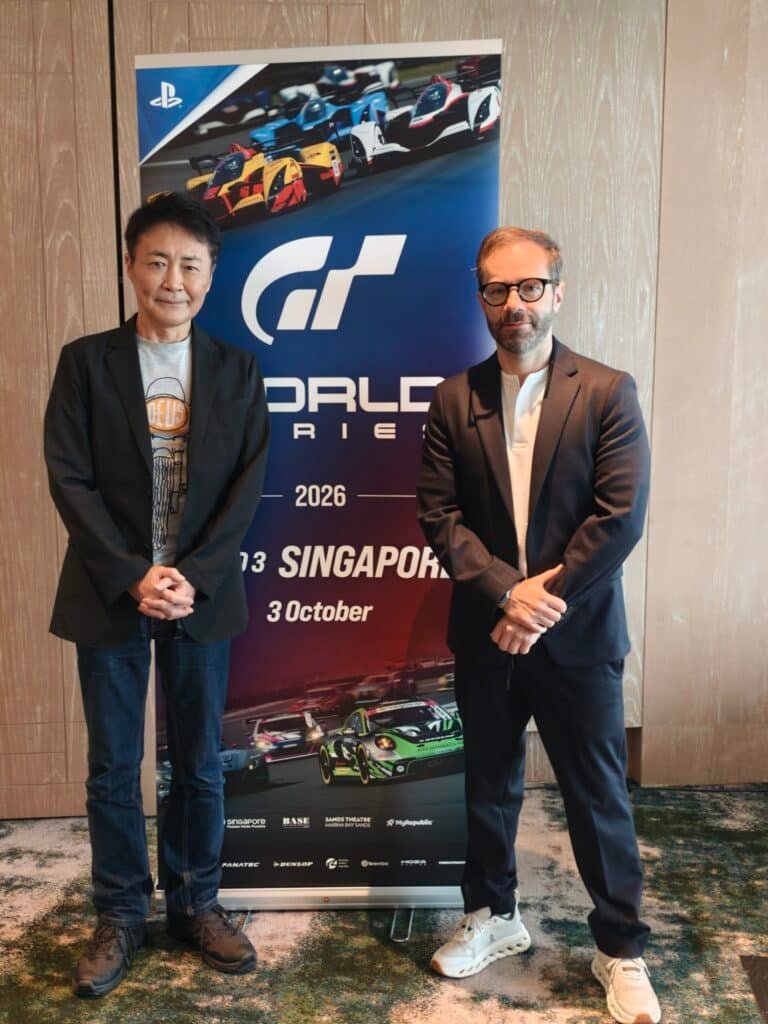
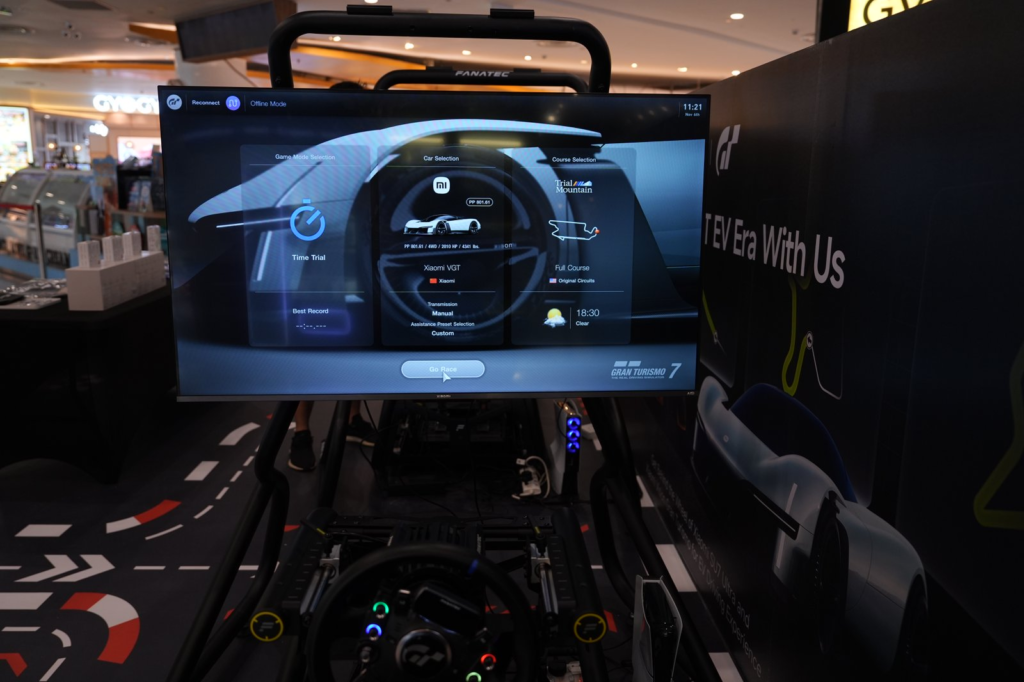
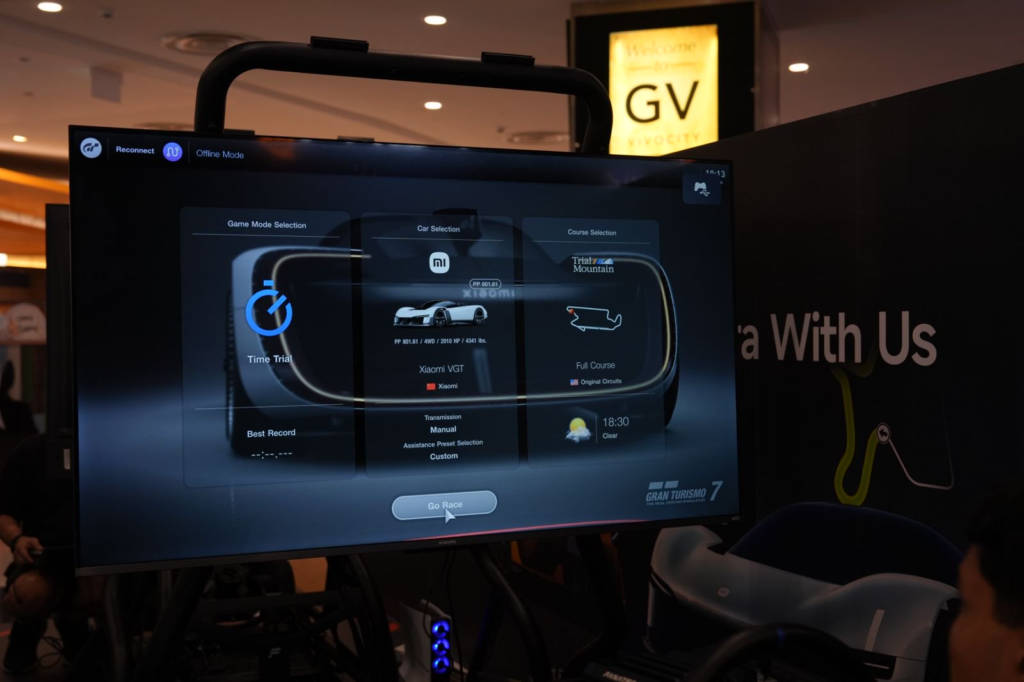
Xiaomi’s Vision Gran Turismo concept has moved from the show floor to the virtual racetrack. At the GT World Series round in Singapore on October 3, 2026, Gran Turismo creator Kazunori Yamauchi and Xiaomi design chief Jean-Arthur Madelaine announced that the car arrived in Gran Turismo 7 in October.
The car is the latest in the Vision Gran Turismo programme, which has invited carmakers since 2013 to design dream concepts exclusively for the game. Xiaomi is its 36th brand and its first technology company. Its concept debuted at Mobile World Congress in Barcelona earlier this year, then appeared in physical form at Auto China in Beijing.
The design philosophy is “Sculpted by the Wind”. Instead of sharp creases and bolt-on wings, a teardrop-shaped cabin appears to float within a body shaped around airflow. The cross-shaped headlights guide air, and the halo taillight sits within the rear air channel. Together with an active wake-control system, these details give it a drag coefficient of 0.29. Xiaomi notes that this and its other performance figures come from simulated testing, not real-world driving.
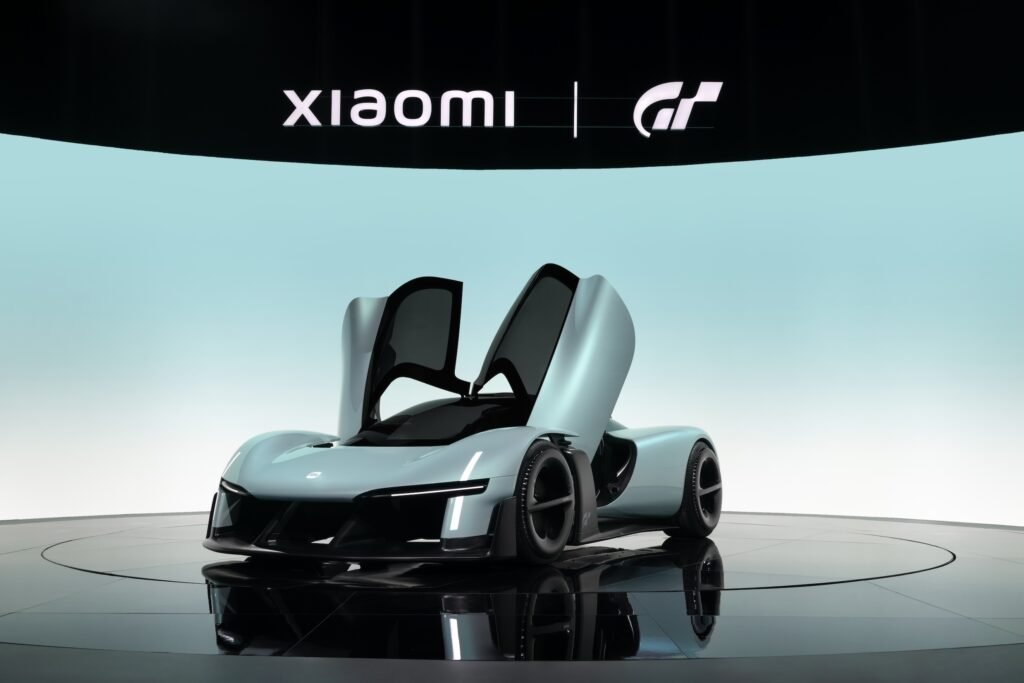
Inside, the “Sofa Racer” cockpit wraps around the driver like a cocoon and is built around Xiaomi’s AI voice assistant, which aims to anticipate what the driver wants and connect to the company’s wider smart-home ecosystem. Yamauchi praised its sleek, curvy lines and predicted it would become a role model for this era. Madelaine said that in the game, the car stays fast and stable while feeling remarkably smooth to drive.
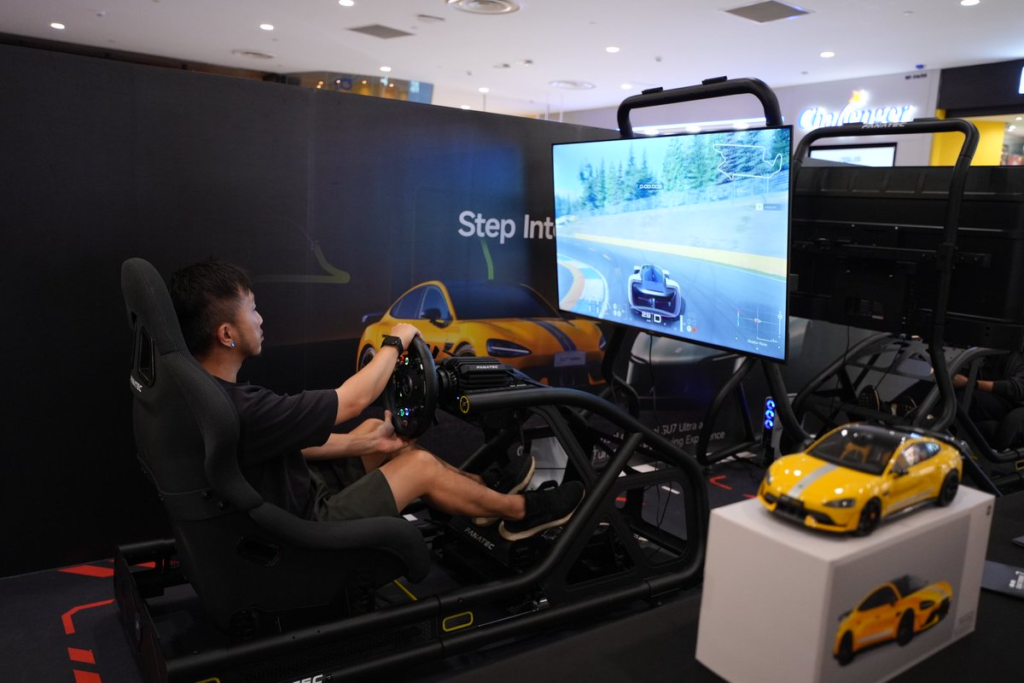
Gran Turismo 7 is also getting its first EV Experience, a set of events built around the Xiaomi SU7 Ultra and the Vision GT. They let players explore how high-performance electric cars accelerate, brake and handle. Players will be able to drive the Vision GT at circuits including the Nürburgring, Le Mans and Suzuka.
NYLON interviews both Yamauchi and Madelaine on the collaboration.
Questions for Kazunori Yamauchi:
What did you learn from driving the SU7 Ultra, and what made Xiaomi the right first technology company to invite?
The initial start in the car is very smooth and feels like a high quality car, but as soon as you floor the throttle it shows a level of extreme acceleration that is like being hit in the back with a massive hammer. And even so, its stability is very high. It took a little time to get used to its sense of acceleration, but as I drove it more my trust of the car continued to become higher and higher.
I was surprised when driving on the Nordschleife of the Nürburgring, that I didn’t feel nervous at any point on the track.
Xiaomi’s level of curiosity and passion for technology, and their diligence that supports this is something I felt is similar to that of Polyphony Digital, and this reinforced my feeling that this relationship is very important to us.
How did you test Xiaomi’s claim that they resolved the contradiction between low drag and high downforce?
In Gran Turismo, we use an aero map that expresses aerodynamics, in addition to several hundred other vehicle dynamics parameters.
These aero maps are made in CFD’s and wind tunnels. Low drag and high downforce is expressed in game as a number in this aero map, and of course you will feel this when driving in GT7.
How do you represent an electric hypercar’s real limits in the game?
Because Gran Turismo is a physics simulation, you will see the same limit of performance as in real life. That’s something that is in a way, automatically recreated on its own.
The “Sofa Racer” cabin and the Xiaomi Pulse assistant are built around a relaxed, comfortable driving experience. How does that work in a driving game?
Unfortunately it’s not possible to recreate the sofa-like comfort of the real car on our side, but I think you can feel its atmosphere by looking at the interior view. Combining the PSVR2 and the PS5 Pro and experiencing it in VR will provide an even more realistic experience.
Does a car that exists only digitally ever feed back into real production?
The role of digital simulation in today’s car development is becoming bigger and bigger, so whether it be styling, design or performance, the various inspirations gained from simulation I think is affecting the building of future cars in the real world.
Questions for Jean-Arthur Madelaine:
How did the Shanghai and Munich studios divide the work on a car designed for a game?
Two cultures. One vision:
During the development of Xiaomi EV’s Vision Gran Turismo concept car, the dialogue between our Shanghai and Munich design teams became more than an exchange of ideas. It began with emulation — challenging each other, pushing boundaries, and drawing inspiration from two different design cultures. This healthy tension gradually evolved into genuine cooperation, where contrasting perspectives became a shared creative force.
Between Shanghai’s energy and forward-looking spirit and Munich’s design heritage and precision, something unique emerged — a language that neither team could have created alone.
This car would simply not look the same without this cultural mix. Its identity was shaped not only by the ideas we shared, but also by the differences that challenged us, inspired us, and ultimately brought us closer together.
I believe good design is about bringing different ways of thinking together to create something entirely new. The result is a car that neither Shanghai nor Munich could have created alone. Its character, its proportions, and its identity are the product of this cultural mix — shaped by the differences between us as much as by what we share.
The best way to create something extraordinary together is to challenge each other first.
How do you keep Xiaomi’s identity on a car “shaped by the wind”?
I think the answer lies in understanding who we are as a company. Xiaomi is, at its roots, a technology company. We have an engineering mindset, a curiosity about what’s next, and a constant drive to push boundaries.
So, rather than starting from a traditional automotive design heritage, we started from our own DNA. We asked ourselves: what does it mean for a technology company like Xiaomi to design a car? For us, the answer was “shaped by the wind”.
The wind became a way to express our mindset through design: the pursuit of efficiency, the fascination with technology, and the idea that form should emerge from performance and purpose. It’s about removing the unnecessary, embracing fluidity, and letting technology inspire the shape.
We didn’t try to give the car an identity from the past. We tried to express Xiaomi’s identity through a vision of the future. And that, to me, is what makes this concept authentic Xiaomi.
How far did you go in designing for a virtual world, and how much do you hold back for credibility?
We went much further than designing a car that simply looks spectacular on a screen. For us, Vision Gran Turismo was the perfect playground to explore what a Xiaomi performance car could be, without the usual constraints of a production vehicle.
But we didn’t stop at the design. Our engineers defined a proper technical package, we worked on the chassis, the powertrain, and the power delivery to create a car that would offer the best possible driving experience in the virtual world.
Because Gran Turismo is much more than a video game; it is an incredibly sophisticated driving simulator, where the physics of the car, its behaviour, and the way it responds to the driver really matter. You cannot rely on design alone; the car has to work as a complete machine.
We approached it as a real car designed for a virtual world. That gave us the freedom to push the boundaries of performance and imagination, while keeping the engineering thinking at the heart of the project.
In the end, the ambition was not simply to create a car that people would admire on screen, but one they would genuinely love to drive.
What led you to the “Sofa Racer” interior, and what happened to the traditional hypercar cockpit?
The Sofa Racer: redefining the hypercar cockpit.
With the Sofa Racer concept, we wanted to challenge one of the established conventions of hypercar design: the idea that a high-performance cockpit must always be focused on a single, uncompromising driving position, with comfort taking a back seat.
Inspired by the gaming world, we imagined a cockpit that could adapt to different states of mind. When you want to relax, immerse yourself in the experience, or simply enjoy the car, you can lean back and feel at ease.
When it’s time to drive on a race track, the cockpit transforms into a more focused environment, putting you in the right position to concentrate and extract the maximum performance from the car.
The ambition was to break away from the traditional hypercar cockpit, often defined by rigid racing ergonomics, minimal comfort and a very singular purpose.
But that doesn’t mean the project is disconnected from reality. It allows us to explore new design directions, question established conventions and develop ideas that can influence the way we approach future vehicles.
What from this project could realistically reach a production Xiaomi?
What will make it into production is not necessarily a specific feature or a particular shape, but the thinking behind it.
Ultimately, this concept is a statement about Xiaomi’s design DNA, our engineering mindset and our philosophy of creating technology-driven experiences. Even if the next production car doesn’t look like this concept, it can still carry its spirit.
For me, that is the real purpose of a concept car: not to show you exactly what comes next, but to give you a glimpse of how we imagine the future.
All photos courtesy Xiaomi.